The project is aimed at improving the mental health and emotional resilience of young people through the development of emotional literacy, self-regulation skills, and practical strategies for mental health care.
In the context of increasing pressures faced by young people – including school-related demands, economic insecurity, challenges in family and peer relationships, as well as violence in the community and online environments – the project provides structured and continuous support focused on strengthening personal capacities for coping with stress, insecurity, and everyday life challenges.
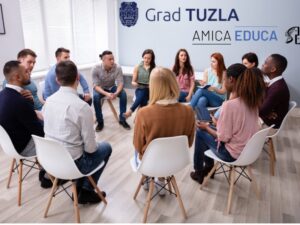
A total of 50 young people are directly involved: 30 young people participate in a structured psychoeducational programme, with the possibility of additional individual counselling and psychotherapeutic support for those with more pronounced needs, while 15 young people are further engaged as volunteers in the co-creation of educational and practical resilience-building tools (resilience toolboxes, cards, and a handbook) and in facilitating peer workshops. An additional 20 young people participate in open thematic peer workshops.
The developed tools and knowledge are further shared with the wider community through peer education, public events, and digital distribution of materials. Indirectly, the project reaches at least 35 educational institutions and youth organisations, around 80 visitors of an interactive exhibition, and approximately 500 citizens through public and media activities.
The project is implemented over a period of nine months (February – October 2026) and concludes with an interactive exhibition marking World Mental Health Day, where the developed tools, self-regulation techniques, and experiences of young participants are presented.
Through a combination of psychoeducation, individual support, youth empowerment, co-creation, and a peer-based approach, the project contributes to the prevention of mental health difficulties among young people, strengthens the culture of mental health care, and actively supports the destigmatisation of this topic within the local community.
The project is implemented through the Regional Programme on Local Democracy in the Western Balkans 3 (ReLOaD3), funded by the European Union (EU) and implemented by the United Nations Development Programme (UNDP) in partnership with 14 municipalities and cities in Bosnia and Herzegovina, including the City of Tuzla.
More information about the programme is available at: The Regional Programme for Local Democracy in the Western Balkans 3 (ReLOaD3) / United Nations Development Programme
The contact person for the project is Merima Salihbegović, Project Coordinator.
For more information:
E-mail: merima.salihbegovic@amicaeduca.ba
Tel: +387 35 248 912